

Grout Solutions, Tile tips
Grout Stain vs. Grout Paint vs. Grout Color Seal: What’s the Difference and Which Should You Use?
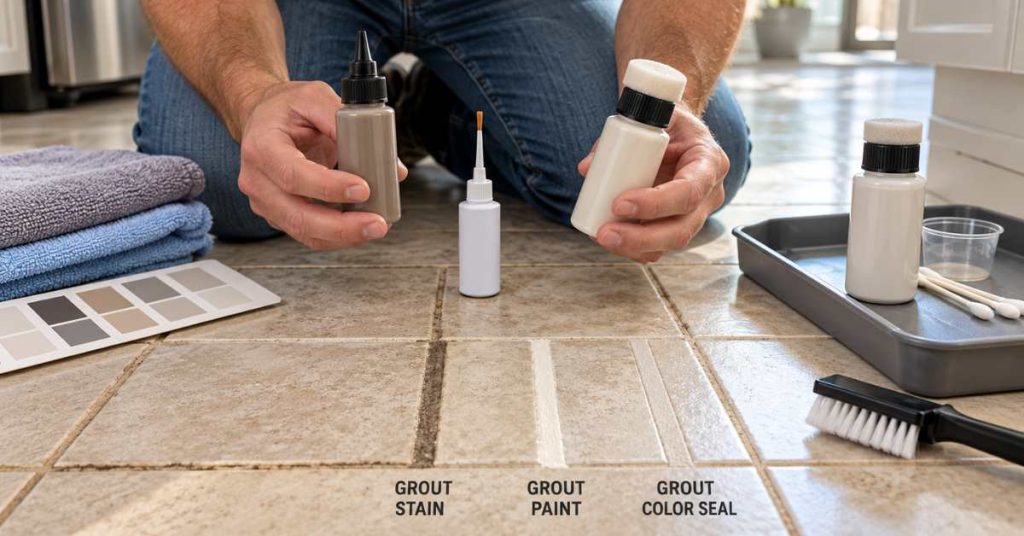
Oct
If the tile still looks good but the grout has become stained, faded, or uneven, replacing the entire floor may not be necessary.
In many cases, the grout can be recolored instead.
That sounds straightforward until you start looking at products.
Suddenly, you see terms like grout stain, grout paint, grout colorant, and grout color sealer.
Are they all describing the same thing?
Not quite.
The terminology often overlaps, and different manufacturers may use the same words in different ways. That is why homeowners should look beyond the product name and ask a more useful question:
What does the product actually do?
Here is a practical look at how grout stain, grout paint, and grout color seal generally differ.
What Is Grout Stain?
Grout stain is a broad term used for products that change the color of existing grout.
Some formulations penetrate the grout more like a traditional stain. Others behave more like a surface-applied colorant.
That is why the word “stain” by itself does not tell you everything you need to know.
Before choosing a product, ask:
- Does it only change the grout color?
- Does it also help seal the grout?
- Does it leave a coating on the surface?
- What preparation is required?
- Is it intended for the type of grout you have?
Grout stain can be useful when the grout is still structurally sound but has become permanently discolored.
What it cannot do is repair loose, cracked, or failing grout.
What Do People Mean by Grout Paint?
“Grout paint” is often more of a casual description than a precise product category.
Homeowners may use the term for almost anything that gets brushed onto grout to change its appearance.
But ordinary household paint is not a proper grout-restoration product.
Grout sits between tile, gets walked on, gets wet, collects soil, and may be cleaned repeatedly.
That means it needs a product specifically designed for grout joints and the conditions they experience.
A product may look somewhat like paint when you apply it, but it may actually be a specialized grout colorant.
The important thing is not what someone casually calls it.
It is what the product is designed to do.
Why Ordinary Paint Is Not a Grout Solution
Regular wall paint, craft paint, and similar coatings are not designed for grout restoration.
They may not bond properly.
They can wear unevenly.
Routine cleaning may damage or remove them.
They also may not provide the stain resistance or durability homeowners expect from a grout-restoration product.
Grout lives in a very different environment from a painted interior wall.
If you want to recolor grout, use a product specifically formulated for grout joints.
What Is Grout Color Seal?
Grout color sealing combines two functions.
First, it restores or changes the grout color.
Second, it creates a protective finished surface over the grout.
That difference matters.
Traditional cement-based grout is porous. It can absorb spills, cooking grease, dirty water, soap residue, and everyday soil.
A grout color seal covers that porous surface with a uniform colored coating designed to help resist future staining.
The result is grout that looks more consistent and can be easier to maintain.
Color Seal Can Bring Back the Original Grout Color
Color sealing does not mean you have to make a dramatic design change.
Many homeowners simply want their grout to look clean and uniform again.
For example, grout that originally looked light beige may have become dark brown in the busiest areas of the floor.
After proper cleaning and preparation, you can choose a Color Seal that closely matches the original shade.
That helps create a more even appearance across the entire floor.
You Can Also Change the Grout Color Completely
Grout restoration can also be an opportunity to update the look of the tile.
Maybe the existing grout is too light and you would prefer something darker.
Perhaps the original brown no longer works with new cabinets or countertops.
You might want gray grout with white tile.
Or maybe you want the grout lines to blend more closely with the tile so they stand out less.
Color sealing allows you to change the appearance without removing the existing tile or replacing grout that is still in good condition.
Grout Stain and Color Seal Can Overlap
This is where the terminology becomes confusing.
Some companies use the term “grout stain” for a product that also seals the grout.
Others call the same type of product a grout colorant.
That means you cannot assume that every product labeled “grout stain” only changes the color.
This Old Grout’s Color Seal may also be described as a grout stain or grout colorant because it recolors the joint.
Its purpose, however, goes beyond appearance.
It also creates a protective surface designed to help resist future staining.
That makes it different from a product whose only purpose is changing the grout color.
